
A major Eastern District of New York ruling in Van Leeuwen Ice Cream LLC. v. Rebel Creamery LLC underscores the importance of consumer survey evidence in trade dress and likelihood-of-confusion litigation.
Keegan & Donato Consulting’s survey work was part of a major trade dress victory for Van Leeuwen Ice Cream LLC in its case against Rebel Creamery LLC.
The dispute centered on allegations that Rebel’s ice cream packaging created a confusingly similar commercial impression to Van Leeuwen’s distinctive pint design. Keegan & Donato was retained by Van Leeuwen to design and execute a reverse confusion trade dress confusion survey measuring whether relevant consumers were likely to associate Van Leeuwen’s packaging with Rebel.
At trial, Mark Keegan testified about the survey’s design, methodology, and findings, including how the research provided evidence that relevant consumers were likely to associate Van Leeuwen with Rebel as a result of the challenged trade dress. The testimony helped explain the role of consumer perception evidence in evaluating the alleged trade dress confusion.
The U.S. District Court for the Eastern District of New York ruled in Van Leeuwen’s favor, enjoined Rebel from continuing to use the challenged trade dress, and disgorge nearly $23.8 million in profits and redesign its packaging.
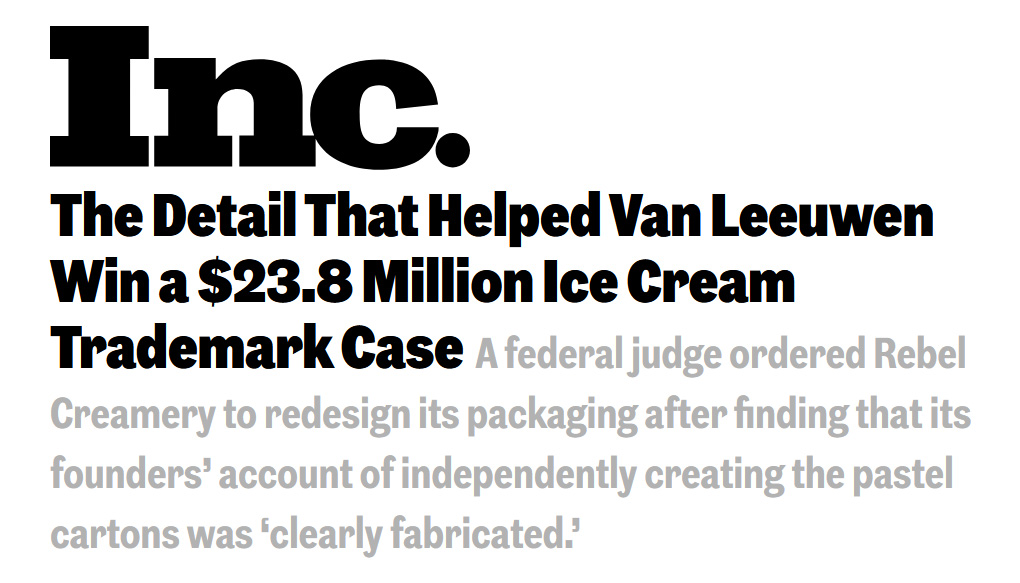
The decision (pdf) has drawn attention from legal and business publications, including Reuters and Inc. Law360 also covered the decision, noting that the court ordered Rebel Creamery to disgorge nearly $23.8 million in profits and redesign its pint packaging after finding that Rebel intentionally copied Van Leeuwen’s pastel, minimalist trade dress. Inc.’s coverage reported that Keegan’s survey found a 34.3% net confusion rate, providing evidence that roughly one-third of surveyed ice cream shoppers associate Van Leeuwen with Rebel because of the packaging similarities.
Why the Case Matters
The Van Leeuwen decision highlights an issue at the center of many trademark and trade dress disputes: consumer perception.
Trade dress cases are rarely about one design element in isolation. Color, type treatment, layout, package shape, product category, marketplace context, and the overall commercial impression can all affect whether consumers believe two products come from the same source, are affiliated, or are otherwise connected.
In this case, the survey evidence helped address that practical question directly: how did relevant consumers understand the relationship between the two packages?
Survey Evidence in Trade Dress Litigation
Consumer surveys can be especially important when attorneys need evidence of likelihood of confusion, reverse confusion, secondary meaning, or consumer takeaway.
A properly designed survey can help measure whether consumers believe two products are connected, whether one brand appears to be affiliated with another, or whether a challenged marketplace presentation creates a misleading association.
The Van Leeuwen case also illustrates why survey design must reflect the real-world marketplace. In packaging disputes, the question is not simply whether two labels share visual similarities. The question is whether relevant consumers, encountering the products in context, are likely to draw a mistaken connection.
About Keegan & Donato Consulting
Keegan & Donato Consulting provides consumer survey research and expert support for attorneys in trademark, trade dress, false advertising, Lanham Act, and related consumer perception litigation.
Our work helps legal teams evaluate likelihood of confusion, reverse confusion, secondary meaning, consumer understanding, and the reliability of opposing survey evidence.
Contact Keegan & Donato Consulting to discuss whether consumer survey evidence can support, test, or challenge the claims in your case.