
Trademark survey evidence can play an important role in likelihood of confusion disputes, especially at the preliminary injunction stage.
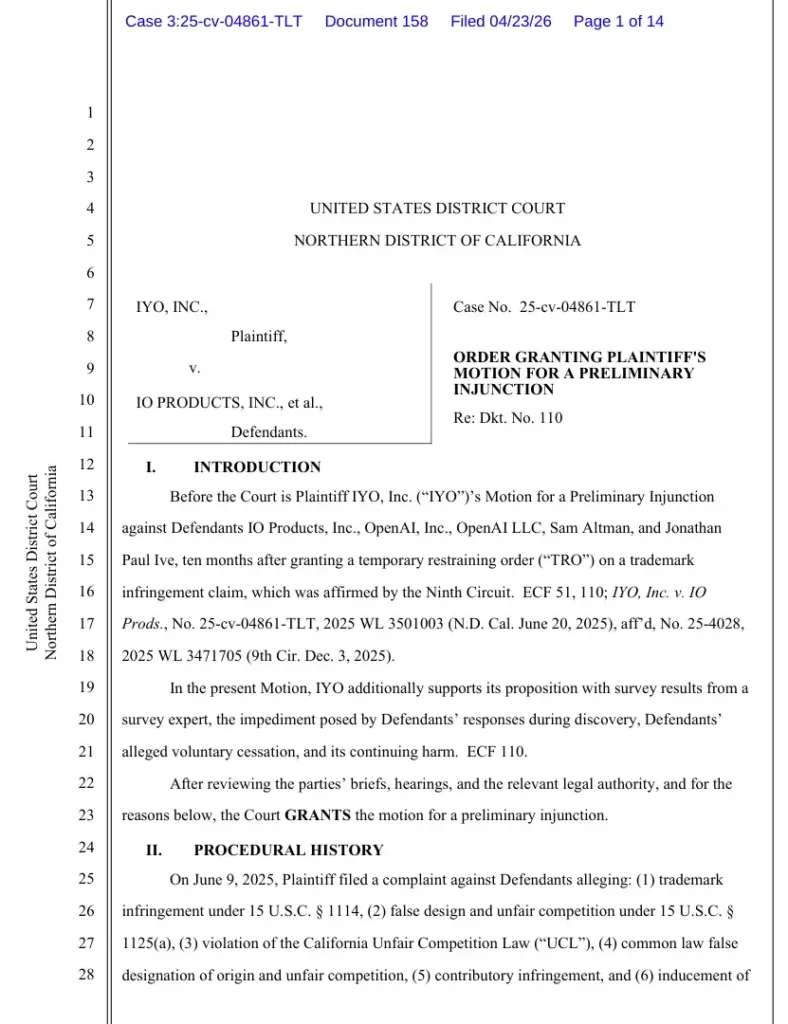
In IYO, Inc. v. IO Products, Inc., OpenAI, Inc., OpenAI LLC, Sam Altman, and Jonathan Paul Ive, the court granted IYO’s motion for a preliminary injunction after considering consumer survey evidence submitted by Mark Keegan.
The defendants challenged the survey’s methodology. But the court noted an important gap in the record: Defendants criticized the survey without submitting competing consumer survey evidence of their own.
For trademark litigators, the order is useful because it shows how trademark survey evidence may affect the factual record before trial. It also highlights a practical point in survey rebuttal strategy: attacking a survey is not always the same as replacing it with contrary evidence.
Why Trademark Survey Evidence Mattered
The dispute involved Defendants’ use of the “IO” branding mark in relation to IYO’s existing mark. To support its preliminary injunction motion, IYO submitted a consumer survey conducted by Mark Keegan.
The court described the survey as finding 62.3 percent total confusion and 24 percent net confusion compared to the control group. According to the order, confusion was driven by shared letters, similar logos, and near-identical branding between “IO” and “IYO.”
The court considered the survey under the Sleekcraft likelihood of confusion factors, specifically the factor addressing evidence of actual consumer confusion.
At this early stage, the court was not deciding the case on a full trial record. It was deciding whether IYO had shown enough to justify preliminary injunctive relief. That made the available factual record especially important.
IYO had submitted trademark survey evidence. Defendants had not submitted a competing survey showing a lack of confusion.
Defendants Challenged the Survey Methodology
The survey was attacked on several grounds. They argued that the survey did not replicate marketplace conditions, did not include OpenAI branding or other contextual references, and used an overly broad respondent universe.
They also questioned whether the survey population matched the likely purchaser profile for an AI-enabled consumer device.
The court acknowledged those criticisms. It did not suggest that survey methodology was irrelevant. Issues such as respondent universe, marketplace context, product cost, control design, and likely purchaser profile can all matter in a likelihood of confusion survey.
But the court did not treat those criticisms as enough to remove the survey from consideration.
Instead, the court focused on the state of the record. IYO had offered consumer survey evidence. Defendants had critiqued it, but they had not added contrary factual evidence on actual confusion.
As the court explained:
“Plaintiff submitted a consumer survey to demonstrate examples of potential confusion in the marketplace generally.”
The court also noted:
“Defendants critiqued Keegan’s survey without adding factual evidence to the record of actual confusion.”
That distinction mattered. The criticisms may have affected the weight of the survey, but they did not create competing empirical evidence.
Survey Criticism Is Not Always Enough
This order does not mean that trademark survey evidence automatically wins a case. It also does not mean that methodological flaws are minor.
A poorly designed survey can be vulnerable. The relevant consumer universe may be wrong. The stimuli may fail to reflect marketplace conditions. The control may be weak. The questions may be leading. The respondent pool may not match likely purchasers.
Those issues can affect how much weight a court gives the survey. They may become even more important during expert discovery, depositions, Daubert motions, and trial.
The practical lesson from IYO v. OpenAI is more specific: at the preliminary injunction stage, a court may still consider disputed trademark survey evidence when the opposing party offers criticism but no competing survey or contrary consumer evidence.
For defendants, that creates a strategic question. Is it enough to identify flaws in the plaintiff’s survey, or does the record require affirmative evidence of your own?
Litigation Takeaways for Trademark Survey Evidence
For plaintiffs, IYO v. OpenAI shows how trademark survey evidence can help support a preliminary injunction motion. A survey can give the court consumer-facing evidence to consider as part of the likelihood of confusion analysis.
For defendants, the order offers a different lesson. Critiquing a survey may reduce its persuasive force, but it may not neutralize it entirely. When early injunctive relief is at issue, the absence of competing empirical evidence may leave the court with an uneven record.
The strategic question is not simply:
“Can we find flaws in the survey?”
The better question is:
“Will criticism alone give the court enough reason to discount the survey, or do we need evidence of our own?”
That question is especially important in Lanham Act cases where survey evidence may become part of the court’s likelihood of confusion analysis before trial.
Why This Case Matters for Likelihood of Confusion Strategy
Trademark litigators already know that survey evidence can be powerful. What makes this order useful is that it shows how trademark survey evidence can matter before trial, when the court is working with a developing factual record.
The case also illustrates a common problem in trademark litigation. One party may offer empirical evidence of likely consumer confusion. The other party may identify weaknesses in the methodology, survey universe, or marketplace context. Those weaknesses may matter, but they do not necessarily substitute for competing evidence.
For attorneys handling trademark infringement claims, Lanham Act disputes, likelihood of confusion surveys, or survey rebuttal work, IYO v. OpenAI is a reminder that survey strategy is also record strategy.
The question is not only whether a survey can be attacked. The question is what evidence the court will have in front of it after the attack is made.
Related Services
Keegan & Donato Consulting provides independent consumer survey research and expert analysis for trademark litigation and Lanham Act claims, including trademark survey evidence, likelihood of confusion surveys, consumer perception research, consumer understanding studies, trademark survey rebuttal and critique, and litigation support.
In trademark cases, the survey is only one part of the work. The larger challenge is building a factual record that can withstand scrutiny from opposing experts, courts, and litigation deadlines.